Mostrando las entradas con la etiqueta U.S.. Mostrar todas las entradas

8 de noviembre de 2012

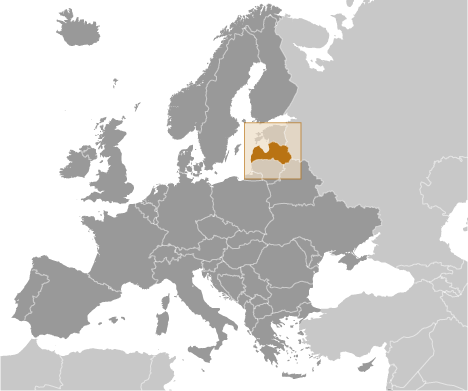
Is it a good business for Latvia investing in Latin America?


Latvian Foreign Minister Edgars Rinkevics seems to think it is.

According to local news, an informative report is being prepared to feed the forthcoming evaluation of Latvia's diplomatic representations, and define the diplomatic development plans until 2020. 

It is envisaged that Latvia will seek to enlarge economic and political relations outside of the EU, especially in India, South East Asia and Latin America. Within that framework, the Foreign Ministry is formally carrying out all of the preparatory work in order to open a new diplomatic mission in Brazil in the short term. 

The following lines will narrow down attention toward Latin America briefly addressing the current economic and political context, as well as the issues and challenges Latvia should take into account in order to build a strategic roadmap that benefits its economic, political, social and cultural agenda.


15 de octubre de 2012

Hugo Chávez's re-election: International implications


Venezuelan president Hugo Chávez has been re-elected on October 7 and will assume his fourth term in power. The opposition leader Henrique Capriles has immediately acknowledged the results, legitimating the electoral outcome.

Official data shows [es] that 55.2% vote for Hugo Chávez and 44.1% supported Henrique Capriles, the United opposition candidate. The total turn out overpass 81%, of the 19-million electorate, being this one of the most attended elections in Venezuela's history.

There is no electoral fraud, intimidation or coercion officially reported so far. Analysts suggest the electoraleffectiveness of Chávez lay on the large amount of cash and resources that the ruling PSUV (Chavez party) uses for continuing political campaigning, the charisma of the leader with a powerful historic and symbolic political narrative, as well as the active social and political structure behind the leadership. 

Also, as Venezuelan analyst Miguel Angel Martinez argues, many people makes a cost-effective calculation wherebyChavez is convenient in the short-run. It is not irrational but rather utilitarian as there are a number of social programmes carried out in the country directly linked to the figure of the leader and the fear of loosing the aid arose as a voting for the ruling regime.

The re-re-re-elected president's first speech was brief, emotive and rather conciliatory. Chávez called to work for a better “revolutionary democratic socialism”, overcoming the polarised political division within the country. Remarkably, Chávez's speech reflects he is aware of the opposition electoral progress and Capriles', a centre-left politician, appears as a key actor in the future. 

Further down I analyse the Regional and international foreign policy implications of Chávez's re-election.